Thomas G. Duncan
Chesapeake Bay Maritime Museum, Uncurated Search Results
Type: Bugeye
Year: 1890
Builder:
Location: Solomons

These records are found in the collection of the Chesapeake Bay Maritime Museum in St. Michaels, Maryland. Uncurated search results are presented to give researchers and interested readers an idea of whether CBMM’s archives contain information about this vessel and whether it may be worthwhile to contact CBMM for further investigation. Uncurated results may be inaccurate or incomplete.
For more information about these items, contact the CBMM curator at collections@cbmm.org, or use the selection buttons below to submit a research request.
Search mode: Exact Name. Search phrase(s): "Thomas G. Duncan"; "Thomas G Duncan". Results returned: 7. Results displayed in this table: 7.
Use these buttons to send uncurated search results to your own app or text document for further research. First, check the box for any row, or click "Select All" then uncheck any rows. Then click "Show Selections". You can then copy your selections from the text box and past them into your app.
| Fetch? | Row ID | Catalog # | Object Name | Title | Artist/Maker | Date Made | Place Made | Description | Full Image | CBMM Cat. Page |
|---|---|---|---|---|---|---|---|---|---|---|
| 1 | 8888.0073.0000.00 | documents | Collection of letters, documents, and legal papers | Range, Cir 01/01/1798 - 12/31/1900 | Part of this collection is on CSC 16B1.Collection of letters, documents, and legal papers relating to the schooners Hunter and Fly:The majority of this collection is composed of correspondence between various parties. Included are letters written to Henry Stouffer, a co-owner of the schooners Hunter and Fly from supercargo and co-owner Andrew Wallace; letters between John Stouffer, the son of Henry Stouffer, and James H. Causten, an insurance broker; as well as several miscellaneous letters. Also included are bills of lading, current account and insurance information, yearly financial transactions, and goods purchased all relating to the aforementioned schooners. Three original manuscripts were typescript by an unknown source and are undated, yet they too appear in the collection together with their originals. There are also two typescripts that do not have manuscripts included in the collection. This collection spans the years 1798 to 1900. Background InformationThe Quasi-War (1798-1801) pitted France and the United States against one another in a power struggle for trade in the West Indies. The French confiscated hundreds of American merchant ships during the war. After the war ended, ship owners began to file claims to Congress in order to seek compensation for their lost vessels and cargo. These claims are known as the French spoliation claims.The Fly was one such vessel that was captured by the French in 1799 presumably near the island of St. Martins. The schooner was owned by Henry Stouffer, his business partner Closs, and Andrew Wallace. Henry Stouffer had begun the inquiry about the Fly in 1823; however, he died before any compensation was received. His son, John Stouffer, Esq., continued the inquiry in 1846 corresponding regularly with James H. Causten, presumably an insurance agent who was advising Stouffer in this matter. Although an included typescript document dated from 1886 indicates that the claims were given to attorneys John and David Stewart, the collection contains no evidence that Stouffer was able to receive compensation for his claim.Stouffer, Closs, and Wallace also owned the Hunter. In 1799 both the Hunter and the Fly began their journey to St. Thomas. Wallace was the supercargo or merchant representative aboard the Hunter and frequently wrote letters to Henry Stouffer remarking on progress, etc. It is presumed that the Hunter was not captured by the French as no spoliation claim was made on its behalf. SubjectsQuasi-War with France; French spoliation claimsIndividuals Represented in the CollectionCaptain Andrews (not known if Seth Andrews is the same person)Seth AndrewsNic(h)olas BowkerJames H. CaustenE.A. ClacknerCloss (business partner to Henry Stouffer, first name is unknown)Captain Comes (first name is unknown)Cook (of Hasham & Cook, first name is unknown)B. FowlerAndrew FinkinCaptain John G. GatchellSamuel H. GatchellSamuel H. Gatchell (Jr.)Sarah R. GatchellWilliam H. GatchellHonorable Giles (first name is unknown)J.(?) Morgan Gom (?)Eleanor M. Gresh (?)Hasham (of Hasham & Cook, first name is unknown)William JacobsHonorable Johnson (first name is unknown)George P. Keeport (private insurance office)Archibald KerrJohn C. LuttigWilliam B. MagruderDuncan McCullanMeyer (presumably business partner to John Luttig, first name is unknown)John M. MeyersCaptain Philips (first name is unknown)Patterson (of the house of Patterson)William PriceHenry StoufferJohn Stouffer, Esq.Thomas Tennant Andrew C. TrippeJames McC, TrippeWilliam VanWyck (of William VanWyck and Co.)Andrew WallaceThomas WearyVessels Represented in the CollectionSchooner AmeliaBrigantine BetseySchooner Bauford, Capt. ComesBrigantine CameliaSloop CharlesShip ColumbiaSchooner Fly, Capt. AndrewsShip HenryHiriam, Capt. BannermanSchooner Hunter, Capt. BowkerSchooner PatrickSchooner PollySchooner RepublicanBrigantine Rover Subject: Henry Stouffer Subject: Andrew Wallace | No image URL. | View | |||
| 2 | 8888.0016.0000.00 | documents | Albert E. Brown and Bro Papers<CR><CR>The collection i | Brown, Albert __Creator | Exact 02/01/1988 - | Albert E. Brown and Bro Papers<CR><CR>The collection is comprised of some of the correspondence and business papers concerning the Brown's Sail Loft in Winona, Maryland. Included are many sail plans for work and recreational boats. These papers were retrieved by museum staff from the derelict sail loft with the permission of the owner. Many are damaged or, deteriorated.Biographical BackgroundAlbert E. Brown and Bro/ sail.1oft~:~was located at Wenona, on the southern tip of the island. The Loft was founded in 1870 by Capt. John Stubbs. In 1890 he was bought out by Henry Brown, born in England, and who served as a seaman in the Royal Navy. He learned the art of sailmaking when he came to the United States during the Civil War and joined the United States Navy.Henry constructed the present building. When he retired in 1919 his son Albert took over the sail loft. Albert's son Henry, in turn, started at the loft when he was 12 years old and took over the business in 1956. Henry G. Brown retired about 1980 and the building has stood empty ever since. In 1986 the old sail loft changed hands.In its heyday, the business was one-of the region's leading sailmakers and had a reputation for old-fashioned, quality workmanship. Orders for sails came from all across the country and from overseas.Scope and ContentThis material represents those papers that were salvagable and that remained in the sail loft after the business had closed. They give considerable insight into the operation of one of the country's most well-known sailmakers.The majority of the papers are correspondence written to the sail loft concerning orders for sails, frequently accompanied by a sail plan and an estimate. Of value are a number of sail plans for the oyster dredging fleet, that the loft kept on file for repeat orders, and letters concerning well-known Bay yachts. Many of these boats have long since disappeared. Sail Loft Amps (1923 - 1974)Brown Papers, p 2An index of boats is available.Correspondence was filed under boat name where it was known, and by correspondent's last name if-no specific boat was mentioned (except for one" design boats which are filed under class name).Other papers include"account books and miscellaneous business papers which provide an overview of 1"the finances of a traditional sailmaking business.Sub'ectsSailmaking Subject: Albert E. Brown and Bro. | No image URL. | View | ||
| 3 | 8888.0044.0000 | documents | Oystering Ephemera Collection | An artificial manuscript collection of materials relating to the oyster industry in the Chesapeake Bay there are 2 series in this collection from different sources.<br /><br />The Series 1 collection consists mostly of letterheads, billheads, price lists, trade cards, labels, and related items, including correspondence for a large number of oyster and seafood packing houses, some of which also dealt with fruit packing. Many of these companies were based in Baltimore, Maryland, but packers in Virginia, Massachusetts, and Connecticut are also represented. Other items in the collection include envelopes, checks, mailing tags, receipts, advertisements, recipe booklets, and ledgers.<br /><br />The Series 2 collection includes photographs and stereoviews, oyster advertising material, restaurant menus, trade cards, comics, sheet music, post cards, business receipts, and books/booklets. The collection is organized by category, Chesapeake related, and general oyster material and was collected by Michele and Clifford Krainik. | 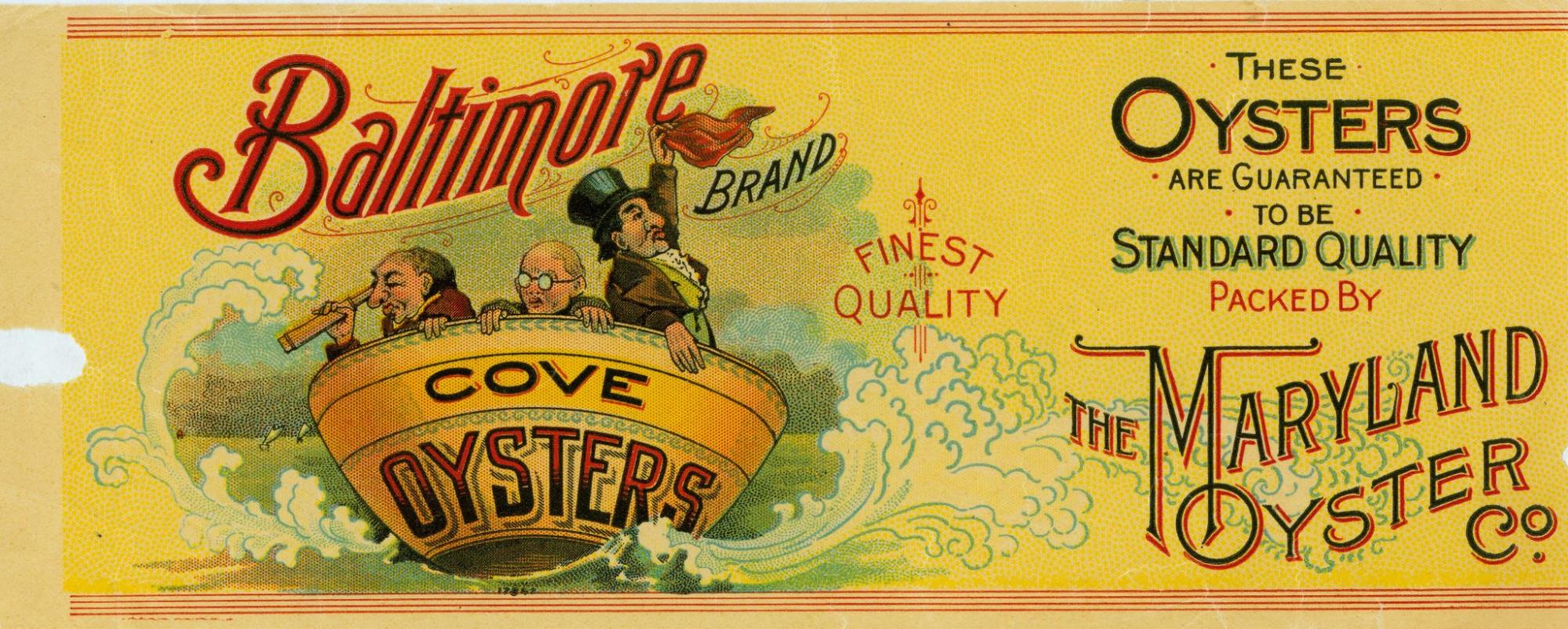 | View | ||||
| 4 | 8888.0054.0000.00 | documents | THOMAS C. GILLMER<CR>MANUSCRIPT COLLECTION<CR><CR>Thomas | Exact 01/01/1981 - 12/31/1993 | THOMAS C. GILLMER<CR>MANUSCRIPT COLLECTION<CR><CR>Thomas C.Gillmer was born in 1911 at Warren, Ohio. He became interested in ships at an early age, entering the U.S. Naval Academy and graduating in 1935. During the late 1930s he served aboard light cruisers in the Pacific and Mediterranean. During World War II he served as an instructor in naval construction, damage control, and marine engineering at the Naval Academy, eventually becoming chairman of the naval engineering department. In 1952 Gillmer wrote Naval Construction a Ship Stability, a basic text still in use in the naval architecture program at the Academy. He retired from active teaching at the Academy in 1967 and began to devote full time to the design of yachts and ship replicas. His first successful yacht design was the 1946 Blue Moon. Subsequent designs were the Southern Cross and Seawind series. He designed Pride of Baltimore 3,(1976-77), the pungy Lady Maryland (1979), and Pride 2L Baltimore 11. (1988). Most recently Gillmer prepared a study of the USS Constitution for her overhaul by the navy. He is the author of several books and numerous articles.See also Oral History tape No. 93 with transcript and list of books and articles.The manuscript collection consists of six papers:1. "Signposts Towards the Origin of Ship Design," prepared for the 5th Naval History Symposium, Annapolis, 1 October 1981.2. "Evolving Ship Design Technology As Revealed in Wrecks of Post Medieval Ships." 3rd International Symposium of Boat and Ship Archeology, Stockholm, 1982.3. "Authentic Replica Ships: Theory and Practice." International Symposium on Ship Construction in Antiquity, Delphi, Greece, August 1987.4. "The Importance of Skeleton First Ship Construction to the Development of Rational Ship Design." International Symposium on Ship and Boat Archeology, Amsterdam 1988.5. "The Second Pride of Baltimore, Her Design and Construction." 9th Sailing Yacht Symposium, Annapolis 1989.6. "USS Constitution: An Assessment for Her Future." Naval History Symposium, Annapolis 1993. Subject: Thomas C Gillmer | No image URL. | View | |||
| 5 | 8888.0191.0000 | research (document genres) | "Notebook on Shipwrecks" research, Moale | Moale, H. Richard | circa 2000s | Research compiled by author Richard Moale while writing "Notebook on Shipwrecks" publishe din 2010. Includes, documentation of vessels, letters, and other data that did not go into the book. | 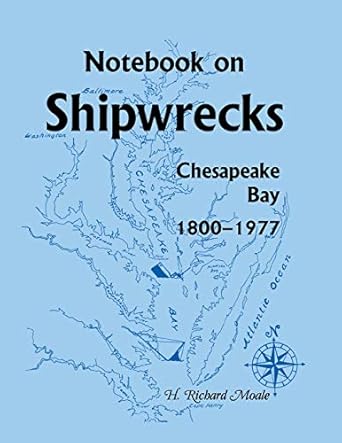 | View | ||
| 6 | 1997.0046.0001.00 | ships logs | Log book of Albemarle | Forbes, William __Writer | Log book of the Navassa Phosphate Company's Chesapeake Bay sailing vessel (bark) Albemarle of Baltimore documenting voyages between Baltimore and Navassa Island for guano. 70 pages, stiff board covers with decorative paper in blue and brown. Smaller loose pages in back. Material: Paper, cotton binding, cardboard, ink. Presumably kept by Capt Wm Forbes, found in grandmothers attic (Glenda Harris) | 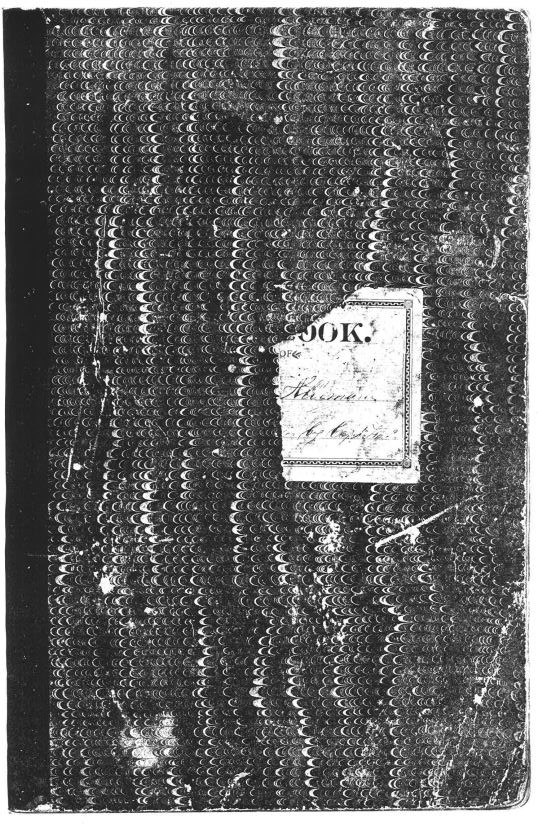 | View | |||
| 7 | 1985.0005.0001.00 | steering wheels | Wood steering wheel reportedly from the sidewheel | Wood steering wheel reportedly from the sidewheel paddle steamer RIVER QUEEN. The wheel has 10 spokes connected to the metal brass hub. On the outer ring there are 10 inlaid metal stars and 10 inlaid wood diamonds. The RIVER QUEEN was built in 1864 and was used by President Lincoln during the Civil War. Condition: The ends of 3 spokes are loose and had been repaired at an earlier time, heavily varnished & discolored. Material: Oak? with metal hub, brass. | 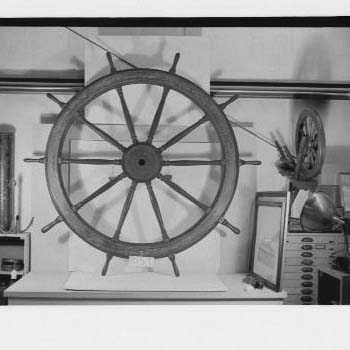 | View |
Created 2026 by Don Barker, CBMM volunteer, for the Chesapeake Shipbuilding Project. shipbuilding@sailingworkboats.es